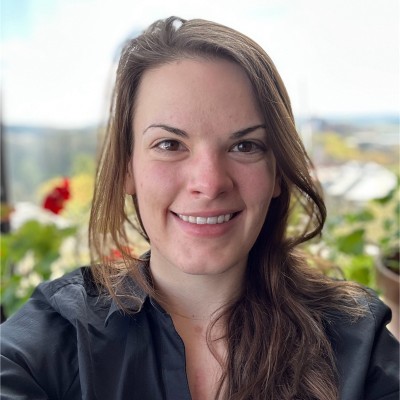
Kathryn Herr, Ph.D.
Researcher in insect–microbe symbiosis
- NIH IRACDA FIRST Postdoctoral Teaching Fellow, Emory University (2024–25)
- Ph.D. Microbiology, Cornell University
- Based in Bath, UK · right to work in the UK (High Potential Individual visa)
I study how microbes and the plants and animals that host them shape one another, from fluorescent bacteria that influence aphid behaviour to the yeasts that travel with a burying beetle. I combine fieldwork, microbiology, and bioinformatics to ask evolutionary questions about everyday symbioses. Alongside that research I teach undergraduate biology and microbiology, and supervise students through research projects of their own.
Academic path
-
 2024 – 2025
Emory University
IRACDA FIRST Postdoctoral Teaching Fellow, Dept. of Biology
NIH Institutional Research and Academic Career Development Award (IRACDA), Fellowships in Research and Science Teaching. Independent research paired with mentored teaching at a partner institution, Morehouse College.
-
 2018 – 2024
Cornell University
Ph.D., Microbiology
Dissertation: The symphony of symbiosis: ecological and evolutionary impacts of microbial interactions with insects.
-
 2012 – 2016
Willamette University
B.A., Biology (minors in Chemistry & Chinese)
Thesis: Secreted extracellular polysaccharide layer prevents phage binding on Caulobacter crescentus.
Research
How do microbes and their animal or plant hosts shape one another over evolutionary time?
Phyllosphere Pseudomonas and aphid behaviour
Pseudomonas spp. · pea aphids
Leaf surfaces carry dense and variable bacterial communities, and the insects feeding there meet those microbes first. For my dissertation I tested how common fluorescent Pseudomonas from the phyllosphere affect aphid behaviour. Different bacterial strains changed that behaviour in substantially different ways, which matters for how these everyday, non-obligate symbioses evolve.
Burying beetles and their Yarrowia symbionts
Nicrophorus spp. · Yarrowia-like yeasts
Burying beetles (Nicrophorus spp.) locate, bury and preserve small vertebrate carcasses, and carry yeast symbionts with them while they do it. Sampling wild populations in the Adirondack Mountains, I examined how diverse these Yarrowia-like yeasts are across beetle species and what their evolutionary history says about how the association is maintained.
Caulobacter exopolysaccharide and phage defence
Caulobacter crescentus · bacteriophage
Caulobacter crescentus secretes an extracellular polysaccharide layer that prevents bacteriophage from binding to the cell. Using confocal microscopy, fluorescent proteins and plaque assays, I measured that layer across diverse strains and how well each resisted infection. Strains investing more in exopolysaccharide grew more slowly, a trade-off between protection and proliferation.
Study systems
- Nicrophorus spp. Coleoptera · burying beetles and their yeast symbionts
- Pea aphids Hemiptera · insect host responding to leaf-surface microbes
- Yarrowia-like yeasts Ascomycota · symbionts carried by burying beetles
- Pseudomonas spp. Gammaproteobacteria · fluorescent phyllosphere bacteria
- Caulobacter crescentus Alphaproteobacteria · exopolysaccharide trade-offs and phage defence
Teaching
-
BIO306: Principles of Microbiology
Instructor · Morehouse CollegeCo-taught this established upper-level course and redesigned parts of it to bring in more active learning and student-centred work, including spreading assessment across more and smaller assignments to make the course more accessible. Wrote, marked and built rubrics for seven assignments, a group project and four unit exams. Taught the unit on microbial interactions and applied microbiology on my own, co-taught the unit on microbial history and cell structure, and held weekly in-person and online office hours.
-
BIOMI 6300: Computational Approaches for Microbial Systems
Guest Instructor · Cornell UniversityDesigned learning outcomes and built a case study from my own research to teach upper-level bioinformatic analysis of next-generation sequencing data, using active learning (think-pair-share, live polling) to explore trade-offs between genomic and metagenomic, shallow and deep sequencing.
-
Software Carpentry Workshop
Workshop Helper · Cornell UniversityGave one-on-one support across a three-day workshop, helping attendees install and use R, RStudio, and GitHub, and troubleshooting issues across Mac, Windows, and Linux.
-
BioG 1500: Investigative Biology
Guest Lecturer & Graduate Teaching Assistant · Cornell UniversityLectured the full 300-student course on the scientific method and hypothesis building, and taught two 3-hour, 18-student lab sections a week. Guided small groups from writing a research proposal on green algae and nutrient limitation through to experimental design, data analysis in R and Excel, figures, and a written scientific article, and supervised the undergraduate teaching assistants supporting the sections.
-
BIOMI 2600: Microbiology of Human Contagious Diseases
Graduate Teaching Assistant · Cornell UniversityFacilitated remote discussions on infectious disease and microbiology, held office hours and small-group review sessions, wrote exam questions, and moved lecture and assessment materials onto Canvas, using its analytics to find where students were struggling.
-
BIOMI 1100: College Dorm Microbiology
Graduate Teaching Assistant · Cornell UniversityLed three weekly 2-hour discussion sections connecting microbiology to everyday life, and guided students through independent projects: writing a proposal, sampling and culturing a microbial community of their own choosing, then analysing the resulting 16S data and writing it up as a scientific article.
-
Microbial Friends and Foes Summer REU
Guest Lecturer & Graduate Teaching Assistant · Cornell UniversityDesigned and taught a recurring workshop on how to read scientific articles for undergraduates from underrepresented backgrounds, and served as a teaching assistant and student liaison for the broader summer research program.
-
BIOMI 2500: Public Health Microbiology
Graduate Teaching Assistant · Cornell UniversityTaught in a flipped classroom where students met concepts through coursework and worked problems in class, guiding small groups through public health case studies and encouraging them to reason through unfamiliar material independently.
-
BIO250: Microbiology (Lab)
Teaching Assistant · Willamette UniversitySupported students in designing and running independent microbiology experiments, set up the laboratory space each week, and prepared all media and reagents.
-
BIO130: Cell Biology & Genetics
Teaching Assistant · Willamette UniversityHeld office hours and exam review sessions, and graded coursework throughout the term.
Teaching training
-
Project Management for Postdoctoral Researchers
Emory University · Project management · mentoring -
FIRST “How To Teach”
Emory University · Teaching · pedagogy -
BIOG 6500: Biology Instructor Training
Cornell University · Teaching · pedagogy -
Teaching & Learning in the Diverse Classroom
Cornell University · Teaching · inclusive practice -
ENTOM 4040: Diversity, Equity & Inclusion
Cornell University · Teaching · inclusive practice
Mentoring
I have advised and supported seven undergraduate researchers through independent projects: three over six years in the Hendry Lab at Cornell, three summer researchers on the Microbial Friends and Foes REU, and an honours research student during my postdoc at Emory. Mentoring is one of the most rewarding parts of the job, and it shapes how I teach.
Skills & Tools
Teaching & Curriculum
Course design & redesign Lecturing (300+ students) Laboratory teaching Learning outcomes Assessment & rubric design Marking & feedback Active learning Flipped classroom Inclusive teaching practice Project supervision Moodle-like systems Online teaching & delivery Workshop delivery
Bioinformatics & Computation
Bash Python R / R Markdown Git / GitHub Docker / Singularity Jupyter / Binder SPAdes / Discovar BWA / Bowtie2 / SAMtools FastQC / CheckM / BUSCO BLAST / RAST / Braker2 MEGA / MetaPhlAn / PhyloPhlAn
Laboratory & Field
Sterile technique & culturing Confocal microscopy Fluorescent proteins Plaque & phage assays Plate reader assays ImageJ DNA synthesis & Sanger sequencing Insect behavioural assays Field sampling & transects Media & reagent preparation
Publications
-
Common fluorescent Pseudomonas in the phyllosphere can influence aphid behavior in diverse waysbioRxiv
-
Draft genome sequences of eight bacterial isolates from Pisum sativum leaf surfacesMicrobiology Resource Announcements, 13(1), e00813-23
-
The Lizard Gut Microbiome Changes with Temperature and Is Associated with Heat ToleranceApplied and Environmental Microbiology, 86(17), e01181-20
-
Exopolysaccharide production in Caulobacter crescentus: A resource allocation trade-off between protection and proliferationPLOS ONE, 13(1), e0190371
Funding & Awards
-
NIH IRACDA FIRST Postdoctoral Fellowship
Emory UniversityNIH Institutional Research and Academic Career Development Award (IRACDA), Fellowships in Research and Science Teaching.
-
Provost Diversity Fellowship for Advanced Doctoral Students
Cornell University · $16,247A competitive one-term fellowship, covering stipend and tuition, for advanced Ph.D. students who have contributed to Cornell's work on inclusion and belonging.
-
Graduate Student Research Enhancement Award
The Coleopterists Society · $1,991Examining the diversity of burying beetles (Nicrophorus spp.) and their associated Yarrowia symbionts in the Adirondack Mountains.
-
Kieckhefer Adirondack Fellowship
Cornell University · $979Fieldwork on burying beetles (Nicrophorus spp.) and their associated Yarrowia symbionts in the Adirondack Mountains.
-
CALS Outstanding Teaching Assistant Award
Cornell UniversityAwarded for teaching BIOMI 1100: College Dorm Microbiology and BIOMI 2500: Public Health Microbiology.
-
Microbiome Hackathon: Best Presentation
Cornell University
Talks & Posters
-
The Symphony of Symbiosis: Ecological and Evolutionary Impacts of Microbial Interactions with Insects
Conference TalkCIHMID Summer Symposium, Cornell University
-
The Symphony of Symbiosis: Ecological and Evolutionary Impacts of Microbial Interactions with Insects
Invited TalkDissertation Seminar, Cornell University
-
An Investigation into Yarrowia-like Yeast Symbionts of Burying Beetles (Nicrophorus spp.)
Invited TalkMicrobiology Department Seminar, Cornell University
-
Investigating the Relationship Between Burying Beetles (Nicrophorus spp.) and Associated Microbial Symbionts
PosterAnimal-Microbe Symbioses, Gordon Research Conference, Lucca, Italy
-
Evolution of Yeast Symbionts from Burying Beetles (Nicrophorus spp.)
PosterAnimal-Microbe Symbioses, Gordon Research Seminar, Lucca, Italy
-
An Investigation into Burying Beetle (Nicrophorus spp.) Symbionts
Conference TalkEvolution Meeting, Cleveland, OH
Outreach
-
Write a Researcher (WAR)
Vice PresidentA pen-pal program connecting high school students across the country with research mentors at Cornell University. I helped build and run the program from its first year, when it reached 200 high-school participants nationwide, and worked with Cornell to waive the graduate-school application fee for our participants.
-
GRASSHOPR
Teaching FellowThe Graduate Student School Outreach Program connects STEM researchers with K-12 students in underrepresented districts of Tompkins County, NY. I co-developed and taught multi-day lesson plans for elementary classrooms on decomposition, immunity, and the history of microbiology, spotlighting diverse and underrepresented microbiologists.
-
Expanding Your Horizons (EYH)
BuddyA yearly conference for hundreds of 7th–9th grade students from backgrounds underrepresented in STEM. I escorted student groups through a day of hands-on scientific learning.
Other Notable Research & Lab Experience
-
Production Associate I
Blue Heron Biotech, LLC · Bothell, WAPerformed DNA synthesis and sequence analysis within a multi-disciplinary team, meeting accuracy and throughput goals on the company's proprietary gene-synthesis platform. Ran Sanger sequencing and helped maintain the lab's pipetting robots.
-
Field Technician
Willamette University, Dept. of Biology · Delamar Valley, NVStudied the coevolution of Joshua trees (Yucca brevifolia) and yucca moths (genus Tegeticula) as part of a five-person field team under demanding desert conditions: surveying insect populations, running transects of Joshua tree seedlings, and collecting samples for lab analysis.
-
Laboratory Technician
Willamette University, Dept. of Biology · Salem, ORResearched evolutionary competition in Caulobacter crescentus using confocal microscopy, fluorescent proteins, and plaque assays to characterize extracellular polysaccharide layers across diverse strains. Supervised three junior research students and wrote up the work as a first-author publication.